Discover YouTube
(Product Market Research) Case Study for a research-led content curation project for YouTube in Sub-Saharan Africa

© Toye Sokunbi
Role: Project Lead / Lead Consultant
Client: YouTube Africa
Timeline: 24 weeks
Duration: February 2022 - July 2022
Target Demography: Sub-Saharan Africa
Team: Danjaji Anwar, Vallerie Muthoni, Mayuyuka Kaunda, Adeshina Ladipo, Amarachi Agwu
Thanks to increased mobile internet penetration across sub-Saharan Africa, on-the-go content streaming is the next frontier for media consumption on the continent. YouTube is already a major player in this market and with an estimated 500 hours of content uploaded per minute globally. Intuitive content curation that caters to audience across all ages, cultural and social demographics is a long-term strategy for onboarding Sub-Saharan Africa's growing streaming population.
The Problem
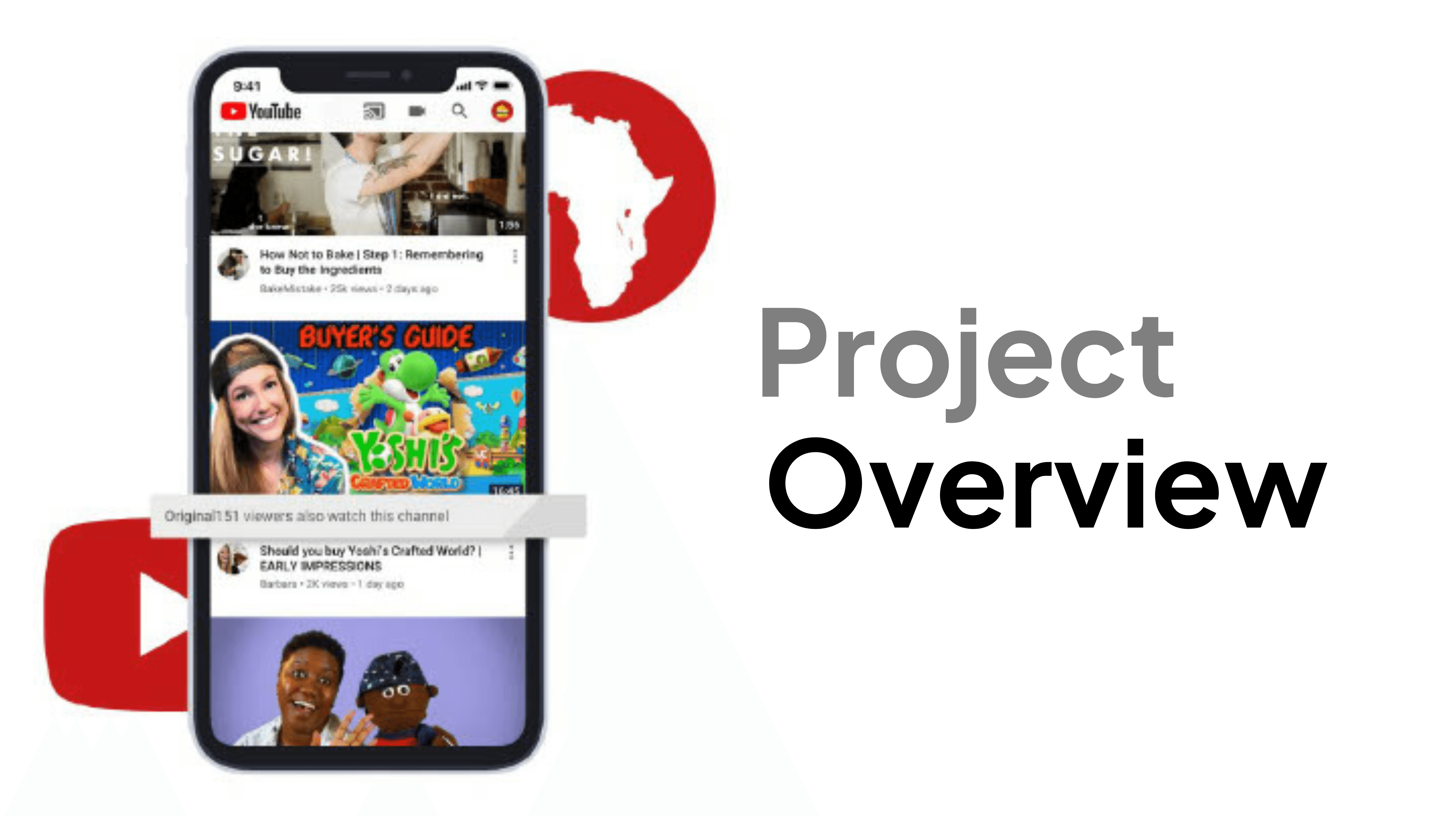
As part of a campaign dubbed "Discover YouTube" aimed at increasing time audiences spent on YouTube, it was uncovered internally that a major roadblock was low visibility for African content creators and low quality recommendations of non-localised content that should be popular with African audiences.
Project Objectives
The main goal for this project is to use localised data on audience behaviour to map YouTube's SSA video consumption habits of its user-base, particularly within ages 18-35. Google's Africa office then contracted me as a content design consultant to help achieve its objectives. The deliverable metrics for success on this project included:
Curation of generative playlists for various genres of YouTube content
Categorising and classifying local and international content recommendations for users based on audience profile, user behaviour and consumption habits
Building and managing a community of contributors and collaborators across sub-Saharan Africa
The Results
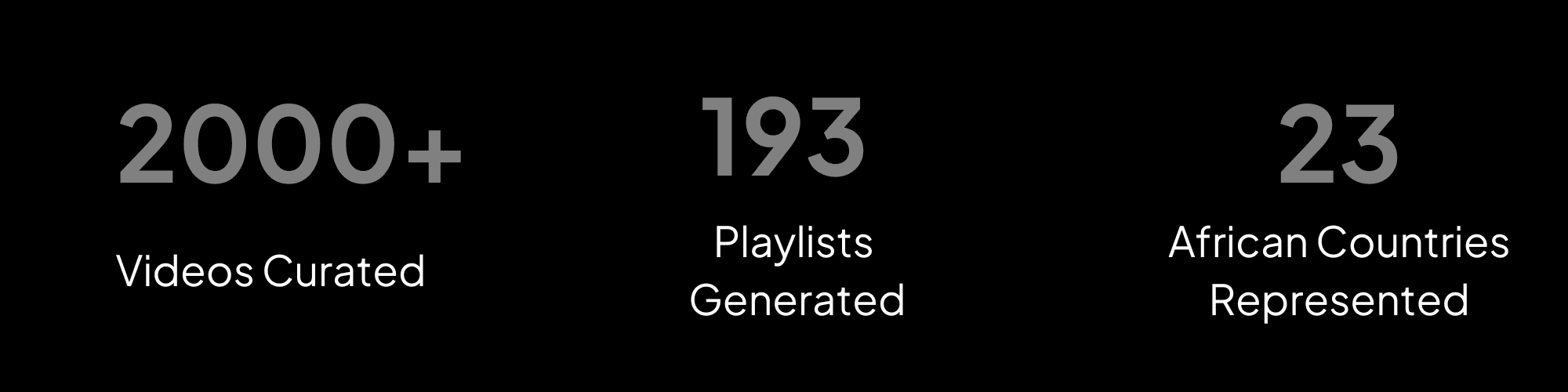
Using the combination of proprietary backend data from Google Africa, surveys and secondary data gained from public YouTube metrics, we created 12 unique audience personas as framework models for mapping for what YouTubing in Africa looks like in 2022.
This helped us appropriately categorise and curate 193 unique playlists and a total of 2000+ videos, hand-picked and taste-curated for audiences spanning Anglophone and Swahili Africa.
The Process
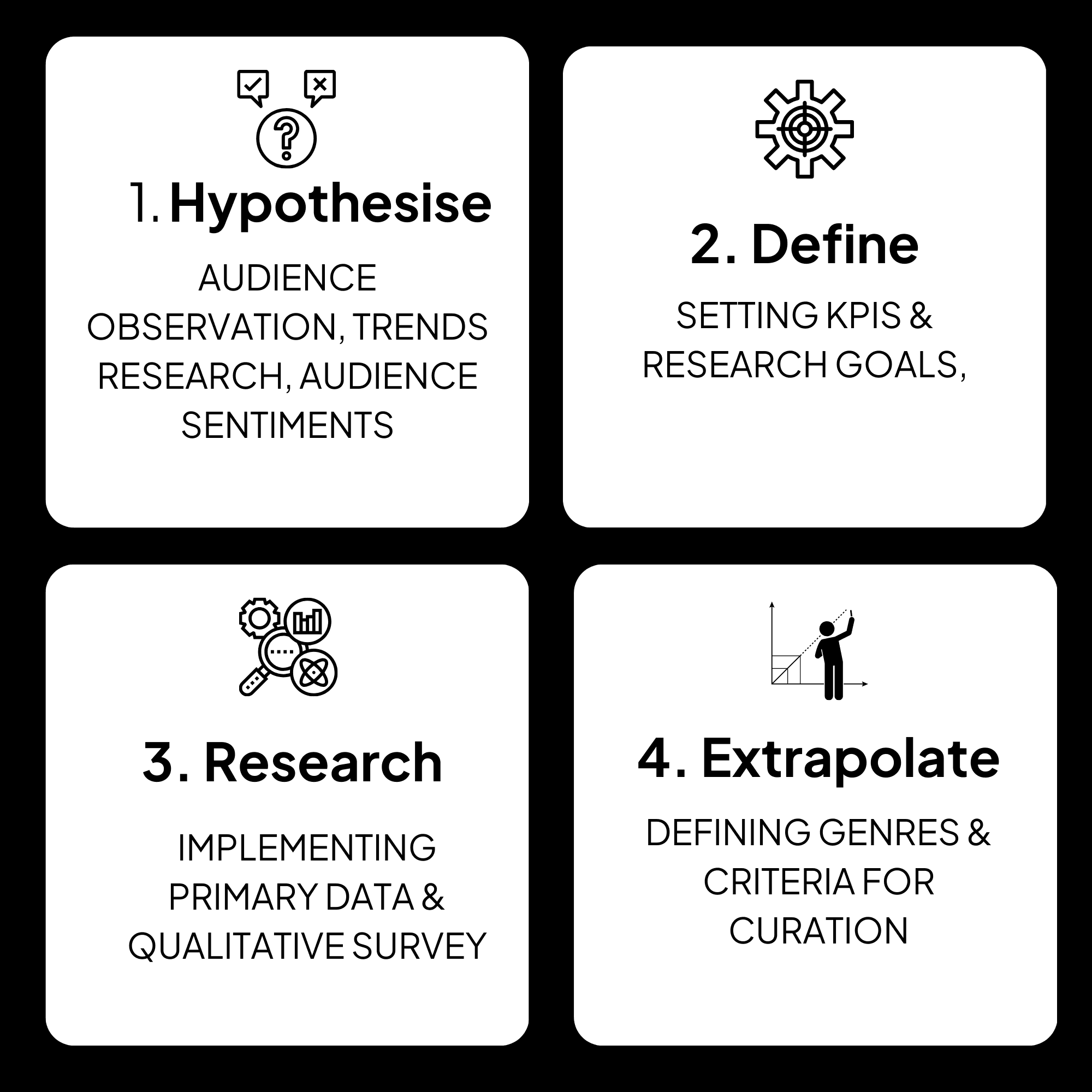
Scope: Proposal Design, Survey Design, Copywriting, Operational Budgeting, People Management, Analysis and Feedback, Quality Control
Tools: Typeform, Google Docs, Google Sheets, Asana, Slack, Canva, Figma
I was responsible for interfacing with Google to initialise the project, proposing a hypothesis for audience profiling and a strategy for project execution. I also recruited and worked with a team of freelance researchers, collaborators and curators from all over Africa to ensure the integrity of the research and the relevance of the curated playlists.
My Approach
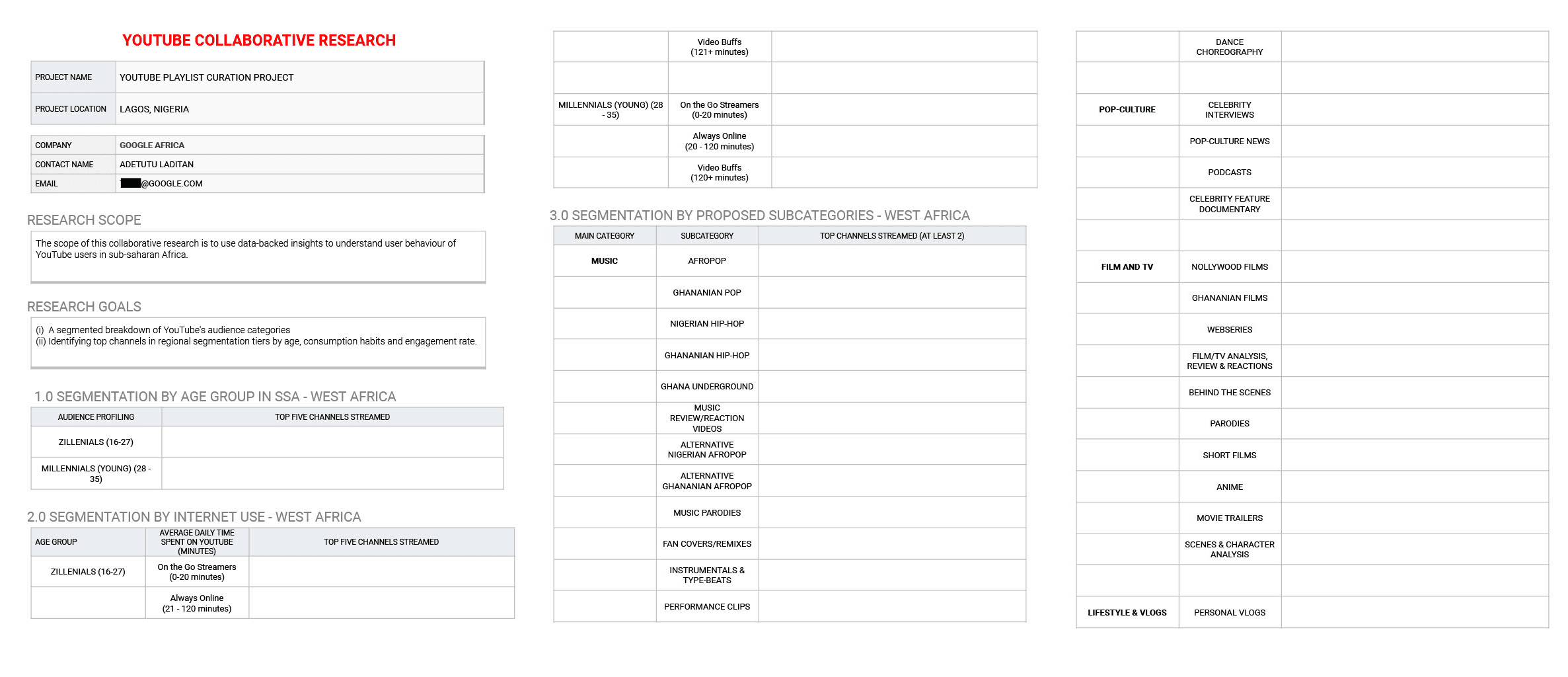
For this project lifecycle, my primary role was to identify the defining characteristics of different audience categories to enable the iterative creation of generative playlists. My direct responsibilities included:
Collaborating with Google to organise and repurpose primary data about user behaviour
Designing a research methodology
Creating a pan-African collaborative research work sheet
Designing a Typeform questionnaire to gain additional user context
Analysing results to generate audience profile models
Defining criteria for playlist curation
Playlist-by-playlist quality control to validate content relevance
Audience Matrix
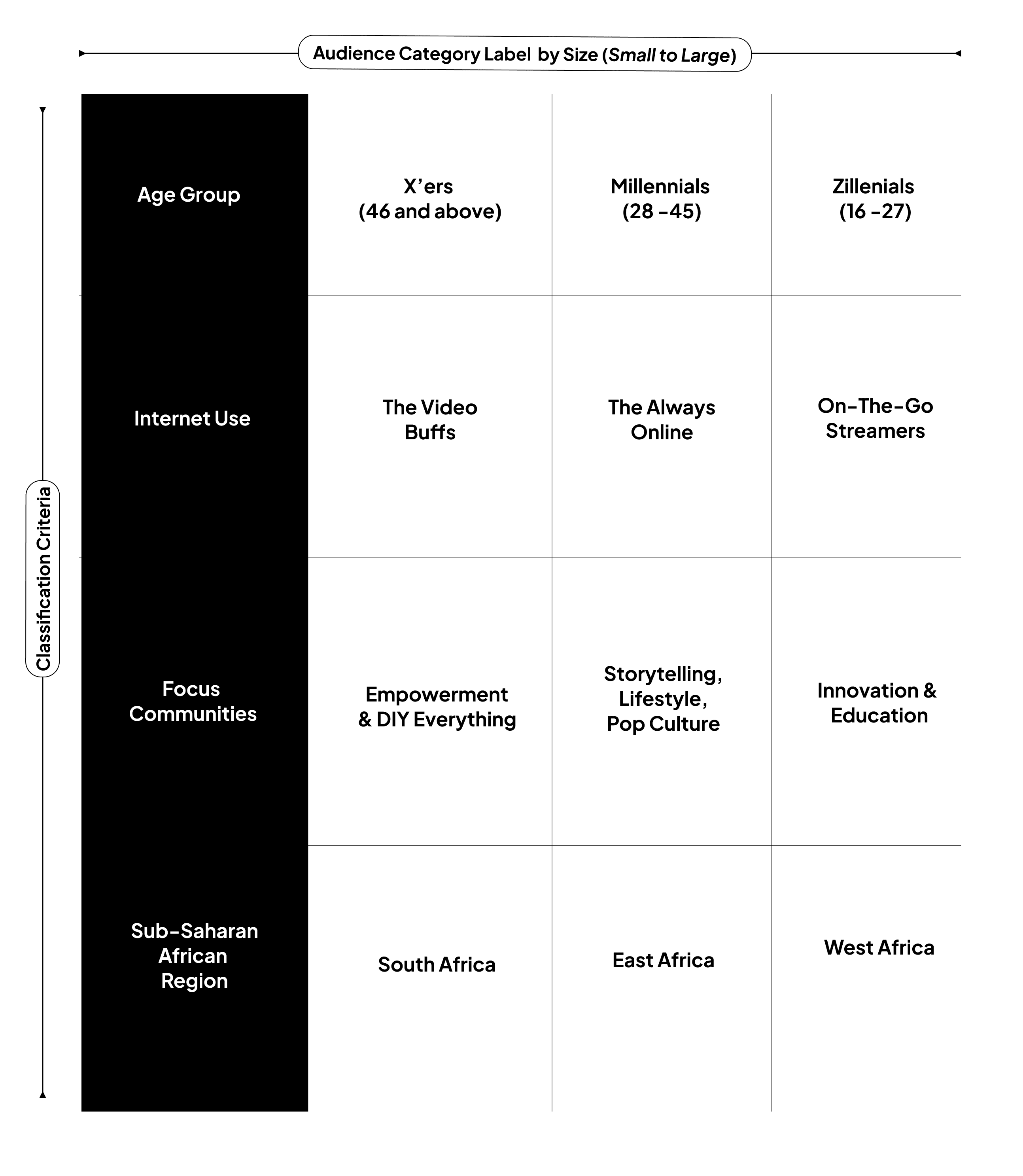
Based on insights made available by Google Africa, YouTube SSA's core user base identifiers are age group and time spent online. Combining this knowledge with our survey on user preferences, we were able to further classify Google's original audience groupings into clusters categorised according to niche interests and location. This served as background research for the creation of a 12-persona audience profile framework that served as a standardised measure for curating playlists.
Curation
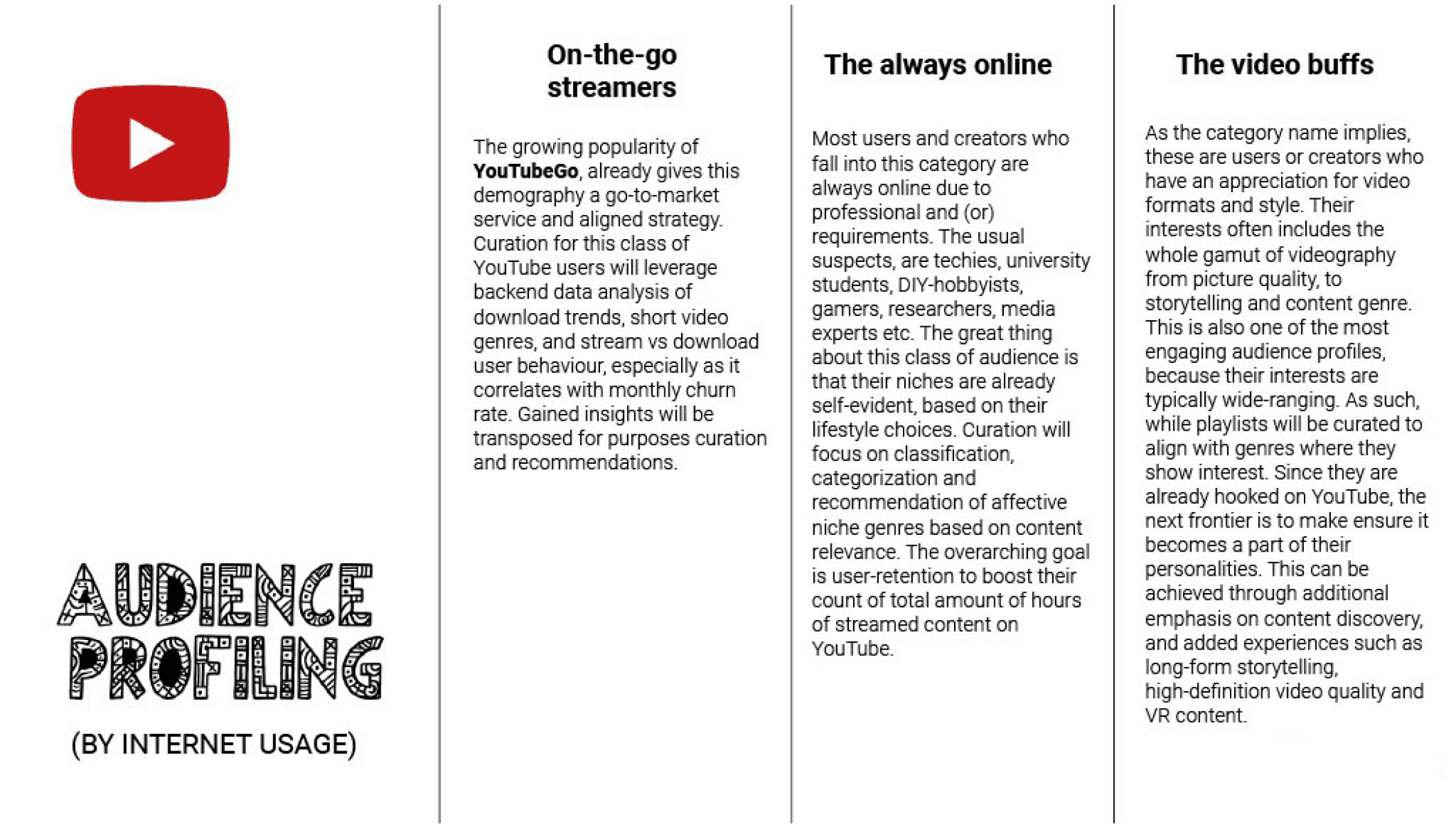
The next step was extrapolating and proposing our audience frameworks as seen in the example summaries above to the Google Africa product marketing team.
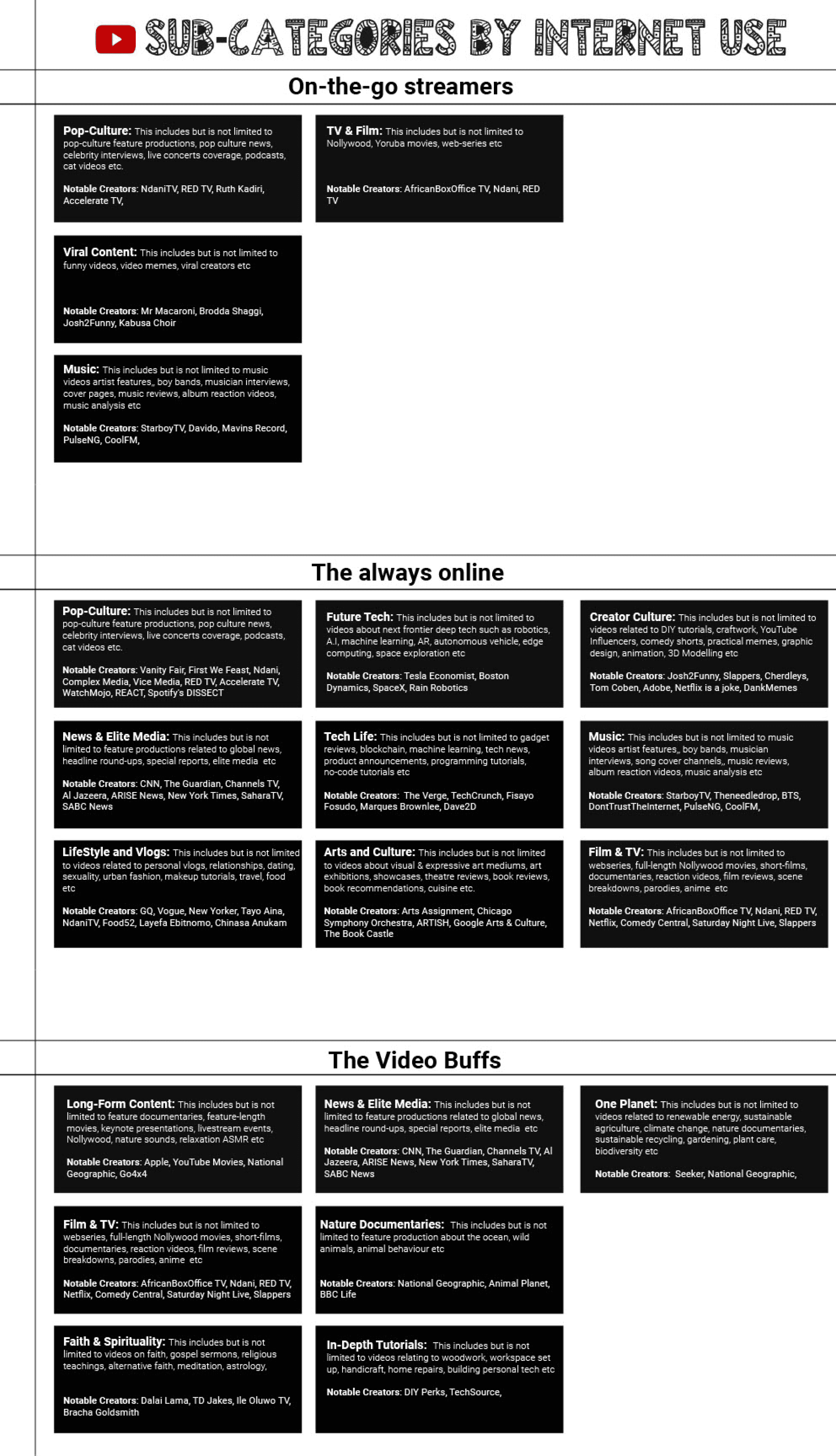
After a series of meetings and deliberations with the Google team, I used the frameworks to organise subject matter and playlist genres, all designed from word/topic clouds (as seen in the example below), which then served as an editorial guide for the curation of playlists.
Project Management
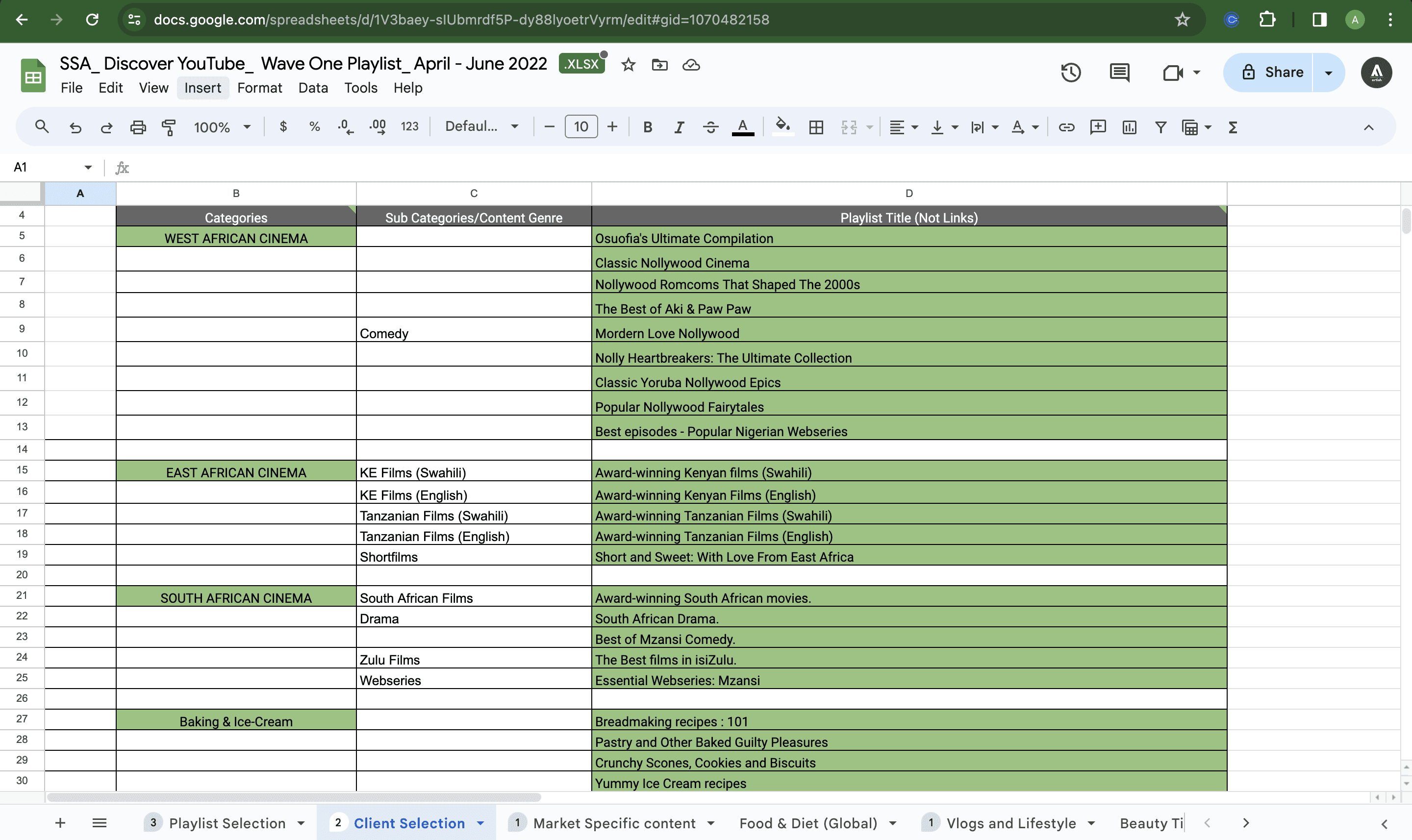
For this project, I recruited a team of three senior curators, each representing regional blocks of West, East and South African content accessible on YouTube. These curators primarily had two main roles: the distribution of survey questionnaires and the curation of localised content into playlists based on relevant audience frameworks. Per the request of Google Africa, playlists were then collated on a central working trix built in Google Sheets.
Post-Mortem: Lessons Learnt, Constraints and Trade-Offs
Lessons Learnt: It's no longer the media or anyone's job to police what is "cool" or not, most people online already know what they like. From international Afropop megastars, to Nollywood movies, Gen-Z creators, tech reviewers and everything in between, countless hours of content enjoyed by Africans is already available on YouTube. The purpose of curating YouTube content for African audiences, therefore, is to aggregate these interests in a way that builds community and aligns with the aspirations of those who identify with these stories.
Constraints: For confidentiality reasons, we couldn't reveal to survey respondents that our client was Google, which meant we couldn't distribute the surveys on social media. As such, to ensure data integrity, we had to also provide regional curators with an additional budget to convince and compensate survey respondents for their time. The same was similarly done with the curation, as regional curators also had to recruit associate curators from within their personal local networks to improve the precision and transposition of acquired insights. These constraints drove up the original costs I projected would get the work done.
Trade-Offs: After designing the audience framework, the original suggestion from the Google Team on collating the playlists was for my team to curate using a single YouTube account. According to them, this was to enable a real-time feedback loop. Unfortunately, due to multiple curators being active on the same account from different locations across Africa, the provided account from Google Africa got flagged by Google's automated spam-buster for "violating community guidelines". We lost all the playlists we'd curated on YouTube until then and subsequently began manually inputting captions and video outlinks on the sample spreadsheet seen above.
Discover YouTube
(Product Market Research) Case Study for a research-led content curation project for YouTube in Sub-Saharan Africa
© Toye Sokunbi
Role: Project Lead / Lead Consultant
Client: YouTube Africa
Timeline: 24 weeks
Duration: February 2022 - July 2022
Target Demography: Sub-Saharan Africa
Team: Danjaji Anwar, Vallerie Muthoni, Mayuyuka Kaunda, Adeshina Ladipo, Amarachi Agwu
Thanks to increased mobile internet penetration across sub-Saharan Africa, on-the-go content streaming is the next frontier for media consumption on the continent. YouTube is already a major player in this market and with an estimated 500 hours of content uploaded per minute globally. Intuitive content curation that caters to audience across all ages, cultural and social demographics is a long-term strategy for onboarding Sub-Saharan Africa's growing streaming population.
The Problem
As part of a campaign dubbed "Discover YouTube" aimed at increasing time audiences spent on YouTube, it was uncovered internally that a major roadblock was low visibility for African content creators and low quality recommendations of non-localised content that should be popular with African audiences.
Project Objectives
The main goal for this project is to use localised data on audience behaviour to map YouTube's SSA video consumption habits of its user-base, particularly within ages 18-35. Google's Africa office then contracted me as a content design consultant to help achieve its objectives. The deliverable metrics for success on this project included:
Curation of generative playlists for various genres of YouTube content
Categorising and classifying local and international content recommendations for users based on audience profile, user behaviour and consumption habits
Building and managing a community of contributors and collaborators across sub-Saharan Africa
The Results
Using the combination of proprietary backend data from Google Africa, surveys and secondary data gained from public YouTube metrics, we created 12 unique audience personas as framework models for mapping for what YouTubing in Africa looks like in 2022.
This helped us appropriately categorise and curate 193 unique playlists and a total of 2000+ videos, hand-picked and taste-curated for audiences spanning Anglophone and Swahili Africa.
The Process
Scope: Proposal Design, Survey Design, Copywriting, Operational Budgeting, People Management, Analysis and Feedback, Quality Control
Tools: Typeform, Google Docs, Google Sheets, Asana, Slack, Canva, Figma
I was responsible for interfacing with Google to initialise the project, proposing a hypothesis for audience profiling and a strategy for project execution. I also recruited and worked with a team of freelance researchers, collaborators and curators from all over Africa to ensure the integrity of the research and the relevance of the curated playlists.
My Approach
For this project lifecycle, my primary role was to identify the defining characteristics of different audience categories to enable the iterative creation of generative playlists. My direct responsibilities included:
Collaborating with Google to organise and repurpose primary data about user behaviour
Designing a research methodology
Creating a pan-African collaborative research work sheet
Designing a Typeform questionnaire to gain additional user context
Analysing results to generate audience profile models
Defining criteria for playlist curation
Playlist-by-playlist quality control to validate content relevance
Audience Matrix
Based on insights made available by Google Africa, YouTube SSA's core user base identifiers are age group and time spent online. Combining this knowledge with our survey on user preferences, we were able to further classify Google's original audience groupings into clusters categorised according to niche interests and location. This served as background research for the creation of a 12-persona audience profile framework that served as a standardised measure for curating playlists.
Curation
The next step was extrapolating and proposing our audience frameworks as seen in the example summaries above to the Google Africa product marketing team.
After a series of meetings and deliberations with the Google team, I used the frameworks to organise subject matter and playlist genres, all designed from word/topic clouds (as seen in the example below), which then served as an editorial guide for the curation of playlists.
Project Management
For this project, I recruited a team of three senior curators, each representing regional blocks of West, East and South African content accessible on YouTube. These curators primarily had two main roles: the distribution of survey questionnaires and the curation of localised content into playlists based on relevant audience frameworks. Per the request of Google Africa, playlists were then collated on a central working trix built in Google Sheets.
Post-Mortem: Lessons Learnt, Constraints and Trade-Offs
Lessons Learnt: It's no longer the media or anyone's job to police what is "cool" or not, most people online already know what they like. From international Afropop megastars, to Nollywood movies, Gen-Z creators, tech reviewers and everything in between, countless hours of content enjoyed by Africans is already available on YouTube. The purpose of curating YouTube content for African audiences, therefore, is to aggregate these interests in a way that builds community and aligns with the aspirations of those who identify with these stories.
Constraints: For confidentiality reasons, we couldn't reveal to survey respondents that our client was Google, which meant we couldn't distribute the surveys on social media. As such, to ensure data integrity, we had to also provide regional curators with an additional budget to convince and compensate survey respondents for their time. The same was similarly done with the curation, as regional curators also had to recruit associate curators from within their personal local networks to improve the precision and transposition of acquired insights. These constraints drove up the original costs I projected would get the work done.
Trade-Offs: After designing the audience framework, the original suggestion from the Google Team on collating the playlists was for my team to curate using a single YouTube account. According to them, this was to enable a real-time feedback loop. Unfortunately, due to multiple curators being active on the same account from different locations across Africa, the provided account from Google Africa got flagged by Google's automated spam-buster for "violating community guidelines". We lost all the playlists we'd curated on YouTube until then and subsequently began manually inputting captions and video outlinks on the sample spreadsheet seen above.
Discover YouTube
(Product Market Research) Case Study for a research-led content curation project for YouTube in Sub-Saharan Africa
© Toye Sokunbi
Role: Project Lead / Lead Consultant
Client: YouTube Africa
Timeline: 24 weeks
Duration: February 2022 - July 2022
Target Demography: Sub-Saharan Africa
Team: Danjaji Anwar, Vallerie Muthoni, Mayuyuka Kaunda, Adeshina Ladipo, Amarachi Agwu
Thanks to increased mobile internet penetration across sub-Saharan Africa, on-the-go content streaming is the next frontier for media consumption on the continent. YouTube is already a major player in this market and with an estimated 500 hours of content uploaded per minute globally. Intuitive content curation that caters to audience across all ages, cultural and social demographics is a long-term strategy for onboarding Sub-Saharan Africa's growing streaming population.
The Problem
As part of a campaign dubbed "Discover YouTube" aimed at increasing time audiences spent on YouTube, it was uncovered internally that a major roadblock was low visibility for African content creators and low quality recommendations of non-localised content that should be popular with African audiences.
Project Objectives
The main goal for this project is to use localised data on audience behaviour to map YouTube's SSA video consumption habits of its user-base, particularly within ages 18-35. Google's Africa office then contracted me as a content design consultant to help achieve its objectives. The deliverable metrics for success on this project included:
Curation of generative playlists for various genres of YouTube content
Categorising and classifying local and international content recommendations for users based on audience profile, user behaviour and consumption habits
Building and managing a community of contributors and collaborators across sub-Saharan Africa
The Results
Using the combination of proprietary backend data from Google Africa, surveys and secondary data gained from public YouTube metrics, we created 12 unique audience personas as framework models for mapping for what YouTubing in Africa looks like in 2022.
This helped us appropriately categorise and curate 193 unique playlists and a total of 2000+ videos, hand-picked and taste-curated for audiences spanning Anglophone and Swahili Africa.
The Process
Scope: Proposal Design, Survey Design, Copywriting, Operational Budgeting, People Management, Analysis and Feedback, Quality Control
Tools: Typeform, Google Docs, Google Sheets, Asana, Slack, Canva, Figma
I was responsible for interfacing with Google to initialise the project, proposing a hypothesis for audience profiling and a strategy for project execution. I also recruited and worked with a team of freelance researchers, collaborators and curators from all over Africa to ensure the integrity of the research and the relevance of the curated playlists.
My Approach
For this project lifecycle, my primary role was to identify the defining characteristics of different audience categories to enable the iterative creation of generative playlists. My direct responsibilities included:
Collaborating with Google to organise and repurpose primary data about user behaviour
Designing a research methodology
Creating a pan-African collaborative research work sheet
Designing a Typeform questionnaire to gain additional user context
Analysing results to generate audience profile models
Defining criteria for playlist curation
Playlist-by-playlist quality control to validate content relevance
Audience Matrix
Based on insights made available by Google Africa, YouTube SSA's core user base identifiers are age group and time spent online. Combining this knowledge with our survey on user preferences, we were able to further classify Google's original audience groupings into clusters categorised according to niche interests and location. This served as background research for the creation of a 12-persona audience profile framework that served as a standardised measure for curating playlists.
Curation
The next step was extrapolating and proposing our audience frameworks as seen in the example summaries above to the Google Africa product marketing team.
After a series of meetings and deliberations with the Google team, I used the frameworks to organise subject matter and playlist genres, all designed from word/topic clouds (as seen in the example below), which then served as an editorial guide for the curation of playlists.
Project Management
For this project, I recruited a team of three senior curators, each representing regional blocks of West, East and South African content accessible on YouTube. These curators primarily had two main roles: the distribution of survey questionnaires and the curation of localised content into playlists based on relevant audience frameworks. Per the request of Google Africa, playlists were then collated on a central working trix built in Google Sheets.
Post-Mortem: Lessons Learnt, Constraints and Trade-Offs
Lessons Learnt: It's no longer the media or anyone's job to police what is "cool" or not, most people online already know what they like. From international Afropop megastars, to Nollywood movies, Gen-Z creators, tech reviewers and everything in between, countless hours of content enjoyed by Africans is already available on YouTube. The purpose of curating YouTube content for African audiences, therefore, is to aggregate these interests in a way that builds community and aligns with the aspirations of those who identify with these stories.
Constraints: For confidentiality reasons, we couldn't reveal to survey respondents that our client was Google, which meant we couldn't distribute the surveys on social media. As such, to ensure data integrity, we had to also provide regional curators with an additional budget to convince and compensate survey respondents for their time. The same was similarly done with the curation, as regional curators also had to recruit associate curators from within their personal local networks to improve the precision and transposition of acquired insights. These constraints drove up the original costs I projected would get the work done.
Trade-Offs: After designing the audience framework, the original suggestion from the Google Team on collating the playlists was for my team to curate using a single YouTube account. According to them, this was to enable a real-time feedback loop. Unfortunately, due to multiple curators being active on the same account from different locations across Africa, the provided account from Google Africa got flagged by Google's automated spam-buster for "violating community guidelines". We lost all the playlists we'd curated on YouTube until then and subsequently began manually inputting captions and video outlinks on the sample spreadsheet seen above.